Feeds:
Posts
Comments

In the South of Pakistan, near the city of Hyderabad begins the range of Hills known as Ganjo Takar, meaning The Bald Hill.  Shah Abdul Latif, the Sufi saint poet of Sindh had pointed to the secrets held in its folds and my attention has been drawn to an article referring to this subject.

Professor Dr. G.A. Allana, the former vice chancellor of the University of Sindh, Jamshoro, who has written many books on Sindh’s history, culture and language, had also written an article using Latif’s line “Ganjay mein Gun Ghanna” (Bald has Many Folds) as the title.  In his article, Dr. Allana reflects upon his various trips to Ganjo Takar.  Most of these were undertaken during his student days from 1956 onwards.  Taking clues from Latif’s poem, Dr. Allana has traced the sacred routes in these hills that had been traversed by the yogis since ancient times.  He recalls the pre-Partition times when the yogis still arrived in a large group from Gujrat to perform rites at a spot dedicated to Kali.  Located near Fateh Chowk in Hyderabad, Kali deovari actually marks the beginnings of the Ganjo Takar range.  Dr. Allana laments on the loss of history as after Partition the road named after Kali has been ‘converted to Islam’ and renamed as the Hali Road.  From Kali in Hyderabad the yogis would get divided in two groups, one of these would head towards the shrine of Lal Shahbaz Qalandar in Sehwan and the other to the Makli necropolis.  The Makli group of yogis proceeded further West to Balochistan to the temple of Mata Hinglaj, the westernmost Tirtha (sacred place) of the Hindus.  The article also reveals several shrines of Muslim saints and many remains of Buddhist period; most relevant here is Sudheran jo Thul.  Dr. Allana mentions an annual fair at the Thul where Buddhist pilgrims got their heads shaven and performed rituals and where Buddha’s bones were preserved.  This indicates the existence of a cinerary stupa at Sudheran and yet another potential spot to explore the much sought-after Buddha’s ashes.  I thank Dr. Mithal Vakassi for sharing Dr. Allana’s article with me.

To compare the recent reopening of the Afghanistan route to the  US/NATO traffic with an event preceding the First Anglo-Afghan war sounds so hackneyed.  In its simplest sense it may be a repetition of history, a déjà vu; in a serious sense it may offer a lesson from history.  It is difficult to trace any particular similarities between the two episodes but surely the first time opening of the Indus route to the West was akin to letting in the ‘Trojan Horse’ and now Pakistan’s reluctant consent to re-open reminds me of Virgil’s quote “I fear the Greeks even when they bring gifts.”

This time it was the magic word ‘sorry’ from Secretary of State Hillary Clinton that finally convinced Pakistan to agree on opening the road.  In the past it took the scheming of a grand  but ‘highly objectionable’ strategy, as termed by Charles Metcalfe, who later explored Baluchistan.  However, it turned out to be one of the most fascinating spy dramas, rarely had I read the details of a story with such fascination. It began in the year 1830 when a ship arrived at Bombay, with a gift of five dray horses from the King of Great Britain to Maharaja Runjeet Singh, the Sikh ruler of Punjab.  The gift needed to be transported by River Indus by Alexander Burnes, who at that time held a political position in Kutch, the only territory of the British dominions in India that touched the Indus region.

Burnes’ mission was actually part of a larger plan that was prepared in response to the growing Russian influence in Central Asia since the beginning of nineteenth century.  In 1801 Russian hegemony began with the taking over of Georgia from Persia (Iran); by 1825 it succeeded in converting Ottoman Turkey into a submissive ally.  Britain’s ancient phobia that it might cross Hindukush-the dividing line between Central and West Asia-and occupy Afghanistan was revived.  There was yet another fear, expressed best in the words of Lord Ellenborough, that Russia might “secure Persia as a road to Indus.”

Lord Edward Law Ellenborough, the President of the Board of Control of the East India Company, shared his fears with Arthur Wellesley, the First Duke of Wellington and Prime Minister of Britain.  The Wellington government was already drifting towards unpopularity, due to its failure to defend the Greek cause against the Turks and making matters favorable for the Russians.  Ellenborough thus found no difficulty in convincing the Prime Minister and later the Court of Directors of the East India Company that Russian influence should be countered by marketing British merchandize in Central Asian markets. The shortest and the easiest route to those markets was through the Indus as it is now for the US and NATO supplies commuting  from Karachi to Kabul and Kandahar.

Indus traverses through Sindh, Bahawalpur and Punjab, of these three kingdoms Punjab was already on friendly terms with Britain,  Bahawalpur was not considered a problem, but Sindh seemed almost impenetrable. Its rulers had been following an isolationist policy, and fearing an outright denial to the British proposal, authorities in London decided to go disguised to prepare the initial report on the navigability of the Indus.  Information on the Indus region was essential to launch trade in Central Asia and much of the success of the plan depended on the skills of the escort of the horses hence the flamboyant Alexander Burnes was just the right choice. He was already familiar with the terrain of lower Sindh adjoining Kutch. He had served as an interpreter of the British officers in their dealings with the robbers of Tharparkar and had drafted a map of the Thar Desert.  With much  difficulty and delay, Burnes was finally allowed a meeting with Mir Murad Ali Talpur, the ruler of Sindh.  To his surprise he was received warmly and permission to sail through Indus was granted “His Highness addressed me by name; said I was his friend… as my brother had cured him of a dangerous disease.”  Burnes wrote in his travelogue “A Voyage on the The Indus.”

Burnes’ mission was accomplished; he delivered the horses to the Maharaja and proceeded to Kashmir.  His report on the Indus region was tempting enough, amongst the many resources of the land he had also described the display of Koh-i-Noor at the court of Lahore.  In 1832, Britain succeeded to get treaties to navigate Indus signed by the three kingdoms and the road to Afghanistan was eventually used for transporting goods, ammunition, an ill-fated ‘Army of Indus,’ an exiled Afghan King, and an ambitious Alexander Burnes riding by the side of the King.  Britain also succeeded in restoring Shah Shuja ul Daula on the throne of Kabul.  But the victory was short lived, the haughty Afghan tribes’ disapproval of a puppet king led to his murder; Alexander Burnes too was butchered in the bazaar of Kabul and The Army of Indus was annihilated  on its retreat through Afghan passes, it is now remembered as the ‘Army of Retribution.’

Today, on the same crossroads of history, when East and West are engaged in a renewed Great Game lets not overlook the little nuances that play a big role in larger human dramas. Dr. James Burnes may have found his patient an ‘Asiatic Tiberius’ but the Sindhi King had not forgotten his doctor and returned the favor.  Apology by Hillary Clinton may be a diplomatic gesture but even in the toughest code of Eastern ethics, where revenge and chivalry are regarded the highest virtues, forgiveness has a place too.  The Game is not yet over but it is certain that US/NATO withdrawal from Afghanistan will not be as brutal.  It is also hoped that its aftermath will not be as combative (Britain conquered Sindh and Punjab soon after its failure in Afghanistan) though, according to Shuja Nawaz’s article in the AfPak Channel,  United States “longer term presence in Afghanistan is suspect, since those troops are believed by some to have been designated to take out Pakistan’s nuclear weapons.”

The road is still blocked with crowds of protesters and the 9000 containers stuck there since its closure.  The formal US Pakistan Agreement, about to be signed, applies only to supplies that have not yet reached Pakistan. But the clutter needs to be cleared, perhaps this time through negotiations.

One of the  lessons learned from recent history is to have a long term policy for the AfPak region. The decade of 1980s had kept America fully involved in the region to resist against Soviet.  However, it abandoned the region as soon as the Soviet threat receded.  One of the outcomes of this abrupt departure was the Taliban coming to power in Afghanistan.  This time it may be worse, Taliban may not be able to make a comeback but the country can plunge in a never ending civil war and chaos.  The repercussions of such a scenario will further enhance the political instability in Pakistan.  Hence a serious  dialogue with the Taliban before the withdrawal of the US/NATO forces is extremely important for a long-term engagement between US, Afghanistan and Pakistan.  India too could be invited at the negotiating table, as it is fully involved in the reconstruction of Afghanistan, but that may be expecting too much.  All the partners in the Game need to define their roles in the post 2014 period.There will be  mutual mistrust in the negotiating room but a degree of respect for each other is required to clear the road further. Hillary Clinton’s gesture is symbolic, she has walked an extra mile, in all the cultures of that region, Muslim, Hindu, tribal and feudal if a woman approaches with a request it is not denied to her. Such are the subtle conventions of eastern cultures that we need to understand.

The Great Bath of Moen jo Daro is the most known architectural features of the ancient city; it is also the most well-preserved public places.  Whether it was a spot to perform water cults or worship a water deity, we do not know, but the city’s close proximity to River Indus indicates that water indeed was held sacred in Indus Valley Civilization (2600-1900 BCE).  Indus was also revered by the ancient rishis as they dedicated hymns to it in Rig Veda, composed around 1500 BCE.  Water, in fact, remained sacred even after the advent of Islam, Shah Abdul Latif Bhitai (1689-1752) the saint and Sufi poet of Sindh, praises it in his Song of the Ocean (Sur Samoondi):

One who does not make offerings to water

And does not light diyas (lamps) to invoke

Should not hope for union with the beloved

Returning safe from the journey overseas.

The Song describes the maritime trade of the Indus region but it also speaks of its tender side- the anxiety of the seafaring men who left for long journeys and the women who waited home for them. It was written thousands of years after the death of Indus Civilization and yet its verse strikes like a long lost sailor’s message in a bottle washed ashore and discovered in the ruins of an ancient Indus port town.

Indus continued to remain significant in many other ways.  It has been a trade route since ancient times; a boundary line of the Easternmost satrapy of Persia’s Achaemenid Empire and a retreat point of Alexander of Macedonia. Legend has it that the great conqueror had searched its waters for the famed Fountain of Youth.  In the early twentieth century Sven Hedin, the famous Swedish explorer had looked for its source. At the sight of the Lion River, as it is called in Tibet, he made a resolve. “Though it costs me my life I will find some day thy source over yonder in the forbidden land.” In 1907, in his Himalayan journey, he finally discovered that source in Kailash, the highest peak of a Mountain range in Tibet. Indus continues to lure the West in the twenty first century as confirmed by Alice Albinia who “follows the river upstream, through two thousand miles of geography and back to a time five thousand years ago when a string of sophisticated cities grew on its banks.”

In the nineteenth century Britain realized Indus’ value as the shortest possible route to reach the Central Asian markets and compete with the Russian trade. Later it was utilized as the main supply route for British ammunition and army in the first Anglo-Afghan war (1938-1942). After its defeat, Britain felt the need to conquer the Indus region.  Sindh was already nicknamed ‘the Young Egypt.’ The river, its valley, the climate reminded the British officials of the Nile and its environs, Sindh had a desert too. Some of its inhabitants had Semitic features and some looked like the Egyptians and there were some blacks of African origins. Above all there were riches and they may have found these at par with Muhammad Ali Pasha’s Egypt.  Sindh’s neighbor Punjab, with five tributaries of Indus and an eccentric Maharaja possessing Koh-i-Noor diamond, was even richer. Considering the usefulness of their river, their richness and their strategic location near Afghanistan, it was natural for Indus land-Sindh and Punjab along with the little kingdom of Bahawalpur to fall victim to Britain’s colonial design and soon they were conquered.

Annexation of Indus’ kingdoms to Britain’s Indian Empire changed the age-old look of the region. With British law and education, clubs and cricket, roads and railways, buildings and gardens, prisons and zoo the cities were modernized. Changes came to the rural areas also and some of these were huge like the network of irrigation canals that bought immense water and changed the landscape. In 1899 the Governor of Bombay, William Baron Sandhurst, had inaugurated Jamrao, one of the famous irrigation canals in Sindh. Jamrao was the main artery to sustain agriculture through a network of its distributaries that brought water to a large part of barren lands of lower Sindh. One of these was dug from the little town of Jhalori, it ran parallel to our lands, and continued for many more miles westward. We call it Shaakh, literally branch; the Shaakh has bridges every five miles. The first bridge is located right across from our village.  The second bridge or the ten-mile bridge, as the people call it, intersects the road that leads on one side to the town of Jamesabad (now Kot Ghulam Mohammad Bhurgri) and on other to Mirpurkhas, the fifth largest city of Sindh. Running parallel with the Shaakh is the patri, the dirt road that completes its tenth mile from Jhalori to this intersection. The tract of land covered with a network of shaakhs and patris crisscrossing each other in lower Sindh is called the Barrage Land in contrast to the barren land of the lower Sindh.

In 1932, the largest barrage in Asia – the Sukkur Barrage – was constructed over Indus to harness its water for irrigation. The project was a blessing. ‘It had changed Sindh from a desert to a fertile land,’ bragged British officials.  In the long run, however, it caused imbalance in the natural setting and has rendered a large area waterlogged.

The water table under the site of Moen jo Daro has been rising too due to the increased paddy cultivation around the site which requires standing water and which came in enormous supply after the construction of the Barrage. According to one estimate, two thirds of the ancient city is submerged and further excavations are not possible due to waterlogging.  The Pakistan Department of Archaeology had therefore prepared a Master Plan suggesting means of lowering the rising water table and conserving the exposed structures. In 1973 the Master Plan was presented to UNESCO and hence a worldwide campaign called ‘Save Moen jo Daro,’ was launched.  Recently the Master Plan has been updated and the work continues.

Indus, undoubtedly, the water resource of the ancient civilization and modern Pakistan is now showing signs of exhaustion; the distribution of its water had been a source of trouble between India and Pakistan and its redistribution is a sensitive issue between the federal and provincial politics of Pakistan.


In 2011, at an exhibition titled “The Buddhist Heritage of Pakistan: Art of Gandhara” held at the Asia Society Museum, New York, a sequence of ‘carved narrative panels depicting episodes from the life of Buddha’ were displayed.  These reminded me of  ‘carved narratives’ appearing on tiny steatite seals discovered from Moen jo Daro.  Some of these too depict episodes from a civilization long dead.  One of these show a deity standing amidst pipal (banyan) leaves next to a submissive human figure, while images of seven females carved at the bottom of the seal watch the ritual.  There are seals depicting a human figure combating two tigers, these have been compared to human-lion and human-bull contest scenes found in ancient art in Mesopotamia and Egypt.  In his recent writings, Jonathan Mark Kenoyer offers a more logical interpretation to these scenes. According to him the myth of a hero who could grapple with two ferocious animals is probably a story with deep roots extending to the Paleolithic and may have been widespread throughout West and South Asia. Each region probably used familiar animals to represent specific concepts of nature and conflict between various spiritual forces.

There is yet another seal engraved with a three-faced deity, crowned with a pair of horns, seated in a yoga posture and surrounded by animals. This image led Sir John Marshall to consider the deity to be a primordial version of Shiva, the Hindu God; Shiva is also known as Bhutanatha and Pashupati, the Lord of animals.  More relevant here is Marshall’s observation of the deer motif of the Shiva seal and its comparison to the deer beneath the throne of Buddha that symbolizes the Deer Park where he gave his first sermon.

On the surface these samples from Indus Valley Civilization may not suggest a direct link with Buddhism, at the most they can be considered precursors of the form of story telling that evolved in the Gandhara tradition of narrating Buddha’s story.

However, Sir Mortimer Wheeler had once hoped that the stupa that crowns the site of Moen jo Daro might have been built on an ancient temple.  Ernst Mackay, another archaeologist who excavated the site, had similar thoughts.  According to him a sacred place continues to be used for a sacred purpose even by new occupants of a different religion.  The ancient temple beneath the stupa was never found but a whole city marked with non-violent traits was unearthed.  And beyond the City and through the mists of time exists a template of non-violent temperament in the region.  It is this template which is primary where Indus Valley Civilization, Buddhism, Jainism, Bhaktism had befitted well and where Sufism can reign supreme.  Not too far back in times it was logical for Mahatama Gandhi’s non-violent movement to succeed here.  In the absence of tangible evidence this is how we can rely on logic to draw some answers.

After all it was the absence of war related evidence-weapons, military barracks, prisons-that led the archaeologists to label Indus Civilization as the most non-violent ancient civilization.  If there was a war it was ‘between various spiritual forces’ represented by human-animal conflict motif engraved by the ancient scribes from Nile to Indus. The Sufi concept to strive for perfection is not much different from the concept of achieving nirvana in the non-violent religions; both are versions of an inward war to conquer evil within; both are fought on spiritual realms rooted in Indus Valley Civilization and beyond in the settlements buried deep and lost in time.  Archaeologists are not allowed to dig Moen jo Daro but they are vigorously working on Harappa and few other important Indus sites in Pakistan and India.  At the moment they may not be able to reconstruct fully the ideology of ancient Indus but they cannot deny its non-violent traits, perhaps it is time to study past traits in present times.  There are numerous examples of survival and continuity of Indus tradition in the region.

Amidst the many scattered remnants of peace -1500 or so Indus sites, more than a million shrines, many Jain temples and Buddhist stupas- are also records of smaller stupas.  Listed in British records as votive stupas they have vanished without leaving any trace.  These were usually located around the larger stupas, two of these dated between 800-1200 CE, near Bhanbhore are recorded in the 1919 report of the Archaeological Survey of India “the importance of the discovery of these smaller stupas lies in their worship by the modern inhabitants of Sindh.” although the worshippers by that time were Sindhi Hindus of Vani community but the British officials strongly felt that the two ‘bleak…curious monuments were at one time Buddhist Stupas.’ This may or may not have surprised the British officials but this has been the natural response throughout history; devotees flocking to the sacred places even when the labels change from Buddhism to Hinduism to Islam.  Today at the shrines of Lal Shahbaz Qalandar in Pakistan and Nizamudin Auliya’s in India, Hindu devotees can be found in considerable numbers.

Saints, dead or alive, Muslims or non-Muslims, have been messengers and custodians of peace throughout the history of the region.  The areas away from militant Islam still rings with the poetry of Shah Abdul Latif, Bulleh Shah, Rehman Baba and many others. This face of Pakistani Islam is easily distinguishable from the Deobandi Islam that came from India after the Partition.  Sufi Islam also continues to remain distinct from the new militant Islam which matches the Deobandi philosophy taught in the madrasas of the North West regions of Pakistan.  I must emphasize that Sufi Islam is not a sect of Islam it is just the mystical aspect of Islam.  Mysticism is much older than Sufi Islam and had been prevalent in the pre-Islamic religions. Its long history makes it deep-rooted and strong, stronger than the bombs.Destruction by Talibans will make no difference even if all the physical remains of peace, Islamic and pre-Islamic, are eradicated from the face of the region, the non-violent spirit will survive and it may even fly and nestle in regions afar.

In the pre-Islamic days there was a Buddhist sage Padmasambhava from Uddiyana, an ancient town located in Swat, Pakistan.  He had gone to Tibet to preach Buddhism where he came to be known as Guru Rinpoche.  The seed of Buddhism that he planted in Tibet sprouted and spread to Mongolia, Bhutan and surrounding regions.  After the departure of Dalai Lama from Tibet it was exposed to the world and became popular in the West, even in  the most opulent and most worldly of all the institutions, the Hollywood. At this juncture of the history of non-violence another narrative awaits to be carved.


Image

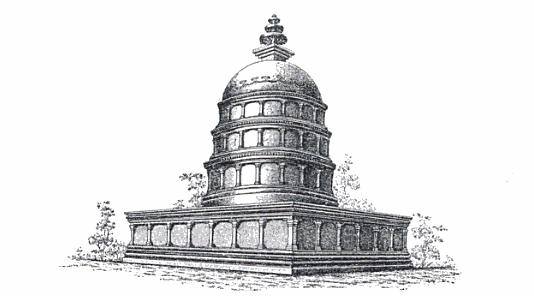
Moen Jo Daro Stupa

“The restoration of the stupa sketched (above) is meant merely to give the reader a rough idea of the appearance it is likely to have presented in the days of the Kushans.” Sir John Marshall.

The recent news about the restoration of the defaced Buddha’s images in Swat is a strong message to those who had been on a spree of vandalizing the pre-Islamic heritage in the region.  Beginning in 2001 with the destruction of the colossal Buddha images in Bamiyan, Afghanistan the mischief had infiltrated in the North Western Pakistan, Vishakha Desai, the former Director General of the Asia Society, New York, was one of the first to report the damages in 2007. Read here.

Many archaeological remains in Pakistan have already been victims of time, weather, waterlogging, thefts and neglect of officials.  Almost nine decades ago, Sir John Marshall had described the sorry state of the remains of the ‘largest and the highest’ Buddhist stupa of Sindh.

“The dome of the monument has long since disappeared and all that is left is the lower part of the circular drum, which is still standing to a height of 8ft. 4in. above the plinth…long before Mr. Banerji’s arrival, villagers are said to have excavated beneath the hollow middle of the drum, to a depth of some 14 feet, in the hope of finding hidden treasures and to have lighted upon a relic casket.  Some fragments of this relic casket, which was of alabaster, were subsequently found by Mr. Banerji in the debris but not enough to its reconstruction.”  Sir John Marshall.

That outer wall of the lower part of the circular drum still exists and crowns the site of Moen-jo-Daro, the metropolis of the Indus Valley Civilization (2600-1900 BCE), located in the Larkana district in upper Sindh.

In 1919 when R.D. Banerji, superintendent of the Western Circle of the Archaeological Survey of India, surveyed the stupa he had no idea that a whole city, separated by three thousand years laid buried only few feet below its foundations.  However, once the city was exposed Sir John Marshall, Director General of the Archaeological Survey of India, announced its discovery with a bang. On September 24, 1924 by publishing an article in the Illustrated London News he informed the World about the greatest archaeological discovery of British India.  It was a discovery that led to the identification of the fourth ancient civilization of the World (Three other known civilizations at that time were in China, Egypt and Mesopotamia).  But let’s not forget the value of the fragments of the relic casket as it is an important clue to understand the lesser-known Buddhist period of Pakistan’s history.   The caskets containing fragments of Buddha’s charred bones and ashes had attracted British archaeologists and officials to the Buddhist monastic complexes scattered in India. With the dawn of the twentieth century they had reached the North Western fringes of their empire where Buddha, according to a legend, had forecasted the flourishing of his religion. Here they rummaged through the cinerary stupas, special stupas that preserved caskets.

Historical records confirm that Buddhism was prevalent in the Indus region at least from the times of Asoka Maurya (273-232 BCE). The King, who after fighting the horrifying battle of Kalinga, converted to Buddhism and looked forward to victories of Dharmmavijaya, the victory of the faith

Amongst his many contributions to Buddhism, Asoka had also retrieved Buddha’s remains entombed originally in eight stupas and redistributed these  in smaller portions to many other stupas.  Mauryan dynasty ended violently in 180 BCE but the strong Brahmin reaction failed to uproot Buddhism in the region. Two centuries later a second grand era of Buddhism was ushered in by the Kushan dynasty which lasted for 125 years. Kushans territories extended from the Indus region to Gandhara which is parts of Punjab, North West Pakistan and Eastern Afghanistan.

Hieun Tsang, a Chinese monk who visited India during 630-644, just about half a century before the Arab invasion listed the Buddhist monasteries.  In Sindh alone there were 460 with 26000 monks.  Most of these were in lower Sindh, concenterated in the Central Delta area, Mirpur Khas, Sehwan and Makran in the Balochistan, province.

Fa-Hien or Faxian another Chinese pilgrim who had visited earlier, some two hundred years after the Kushan rule, describes Taxila, the city known for education, religion and great trade.  Today, its ruins composed of three cities built in different time zones, is a window to diverse cultural layers.  Conquered and constructed one after another by Darius, Alexander, Chandragupta Maurya and the Greco-Bactrian King Demetrius it had been a melting pot where Persian, Greek, Hindu, Jain, Buddhist and Bactrian cultures merged.  Taxila located on three important routes was also a trading center.  The Silk Road provided opportunities to Buddhist traders and craftsmen to sell their goods and raise money to support their monastaries.  The bloom of Gandhara art in the region suggests not only an amalgamation of Indian and Greek styles but also an immense prosperity that afforded monumental artworks.  It was in such lavish times and place under the Kushans that Buddha, for the first time, came to be represented in human form.  The largest Buddha sculptures in the mountain walls of Bamiyan were constructed under their patronage and Moen jo daro stupa was built during their rule.

Kanishka, the most known Kushan King too reached for  Buddha’s remains scattered by Asoka and stuffed these in precious caskets.  When one of these was discovered in an excellent shape in a stupa in Peshawar it made big news was reported in a full page article in the New York Times in 1909.  Another casket was discovered from Kahu jo Daro in the suburbs of Mirpur Khas in my home district Tharparkar in lower Sindh.  During my childhood days I remember passing by it and even playing around in the spacious yard around the stupa and being overwhelmed by Buddha’s images in relief.

Stupas in Sindh were also discovered at Depar Ghangro, Thul Mir Rukan, Jherruck, Mitho Dero, Sudheran jo Daro and as these awaited a thorough search, strong rumors  of a relic casket buried in the stupa on top of the unexcavated mounds of Moen jo Daro reached the British officials. But while the early intruders searched in vain for treasures in the abode of a religion that renounces worldly treasures by the time Banerji reached the hollowed drum the region itself was empty of Buddhism.  Peshawer casket had been handed over officially to the Burmese monks in a ceremony that symbolizes the final expulsion of Buddhism from the land where it flourished for thousands of years.  Nonetheless the presence of Buddha’s bones- many lost but few found- in a close proximity to each other in Pakistan indicate that the land must have enjoyed an exalted sacred status in the Buddhist world.

Indus region is still dotted with some of the most spectacular Buddhist remains in Punjab, Swat and Khyber Pakhtunkwa province whereas many have perished in the saline land and air of Sindh.  The ASI reports as early as of 1919 had described Kahu jo Daro infected with ‘kalar’ salt encrustation and appealed to the Director to dispatch a chemist from Bombay to cure the problem.  In my lifetime Kahu has withered away and the mounds do not bear any semblance to the stupa that I saw half a century ago.  It is time to preserve as much heritage as possible.
Aleph by Coke Studio-Sufi Music and Poetry


The old shrine and its rustic environs looked the same when I last visited it in 2007. Pallid walls topped with a fading green dome and a tattered flag, a few trees around it laden more with ribbons than leaves.  The ribbons were actually rags, reminders of wishes made.  Few women from the nearby villages were gathered around the grave; impoverished, as ever they looked richer in faith. The eldest of them recited a verse of Shah Abdul Latif Bhitai, one of the most revered saints and a Sufi poet buried in another shrine miles away and at that moment beyond her reach.

Far from the turbulent North West region bordering Afghanistan, Chand Maurya’s shrine is located in Sindh, the southern province of Pakistan.  Standing between the towns of Mirpurkhas and Jhalori, and just a mile away from my ancestral village, it is a spiritual sanctuary to many of its devotees from the nearby villages.  In contrast are spectacular and crowded shrines located closer to the cities.  At a distance of only one hundred miles from Chand Maurya is the city of Sehwan that houses the shrine of Lal Shahbaz Qalander; near Hyderabad is Bhit Shah that still radiates with the poetry of Latif; in the heart of Lahore is Data Darbar and on the coast of Arabian Sea in Karachi is the shrine of Abdullah Shah, perhaps the first Muslim Saint of the Indian sub-continent.

Not too far back in times Pakistan’s landscape, especially the rural landscape of Sindh and Punjab was dotted more with shrines than with mosques.  Shrines are the hallmark of mystical Sufi Islam that prevails in most of the non-Arab Muslim World.  It has evolved with the flow of history, inheriting many traits of pre-Islamic faiths and acquiring a transnational character.

In March 2009 when Taliban bombed the shrine of Abdul Rehman Baba in Peshawar, the government of Afghanistan immediately announced to bear the expenses of the repairs of the shrine.  The devotion to saints continues to thrive beyond political boundaries even in these troubled times; a seventeenth century saint and mystic poet, Rehman Baba is revered throughout the Pakhtun land.

History of Islam in the Indian sub-continent begins in 711 C.E with the first Arab Muslim conquest of the Indian subcontinent.  Invading from the Arabian Seacoast, making Sindh the Gateway of Islam, these early conquerors did not force conversions but received a tax from the non-Muslims in lieu of military service. Even later in times and away from Sindh “The battles of Islam were won not by Muslim iconoclasts but by peaceful missionaries,” admits Khushwant Singh, a non-Muslim writer and historian. These peaceful missionaries had been trickling into Sindh even before its conquest; one of them was Abdullah Shah. Once when the much-desired land of Sindh was conquered it became a good testing ground for the early preachers to convince the Buddhist, Jain and Hindu population on a mass scale. Before reaching Delhi, for three centuries, Islam had already flourished and co-existed with the prevailing religions. Later with their message of justice and social equality these preachers were to win many converts in the caste divided society of India. With the passage of time they acquired the status of saints and structures came to be built to house their graves; each shrine was built according to the means of their devotees.

Given the history of Sindh and the early Islam in the region it is natural for the most original form of Sufism to survive in Sindh.  Sindh is the stronghold of Sufi Islam observes William Dalrymple in his op-ed article in The New York Times (Aug.16, 2010) writes:  “The good news is that Sufis, though mild, are also resilient. While the Wahhabis have become dominant in northern Pakistan ever since we chose to finance their fight against the Soviets in Afghanistan, things are different in Sindh Province in southern Pakistan. Sufis are putting up a strong resistance on behalf of the pluralist, composite culture that emerged in the course of a thousand years of cohabitation between Hinduism and Islam.”

http://www.nytimes.com/2010/08/17/opinion/17dalrymple.html?_r=3&pagewanted=all

In the segregated society of Pakistan where mosques, until three decades ago, had remained the premise of male domain, shrines had been spiritual sanctuaries for women since centuries.  Shrines represent the esoteric Islam, unlike militant Islam, this is marked with non-violence of Buddhism and Jainism and festivities of Hinduism.  Devotional songs and trance dance are a common sight at the shrines.  Devotees can be rich and poor, vagabonds and social outcastes, Muslims and Hindus, women and even transvestites. The militant Islamists, however, do not approve this face of Islam and its practices; they had warned the administrators of the Rehman Baba shrine to bar women from visiting it.  On the other hand poor economy and deteriorating conditions of the country in general is causing frustration and more and more women and men are calling on their saints.  Amongst the crowds are a large number of children being used by their destitute parents for begging.  These are the at-risk children most vulnerable to fall in the handsof a Taliban mullah.  Worse yet can happen if they are trained for a suicide-bombing mission for the very shrine that feeds them…Ah poverty.

Thankfully, the militant attacks so far have not been able to deter devotees from visiting shrines.  They continue to invoke their saints by means of vibrant music and dance, the tradition is old and is at the core of Sufi Islam. The provinces of Pakistan still abound in shrines and the numbers in Sindh are splendid. The largest necropolis of Asia located on Makli hill survives with more than a million graves and half of these are said to be of saints.  How many of these the militants can destroy? “The Taliban have antiaircraft weapons, rocket-propelled grenades and squads of suicide bombers. But the Sufis have drums. And history.” Writes Nicholas Schmidle in his article in the Smithsonian Museum. http://www.smithsonianmag.com/people-places/Faith-and-Ecstasy.html?c=y&page=1

SHARMEEN OBAID CHINOY

Sharmeen Obaid Chinoy is an Academy Award and Emmy Award winning documentary filmmaker. Her recent films include SAVING FACE, TRANSGENDERS: PAKISTAN’S OPEN SECRET AND PAKISTAN’S TALIBAN GENERATION, which aired on PBS, Channel 4, CBC, SBS and Arte and was the recipient of theAlfred I Dupont Award as well as The Association for International Broadcasting award. Sharmeen has made over a dozen-multi award winning films in over 10 countries around the world and is the first non-American to be awarded the Livingston Award for best international reporting.  In 2012 Time Magazine included her in the magazine’s annual list of the 100 most influential people in the world. (Read more on the link below)

http://sharmeenobaidfilms.com/bio/

ANOUSHKA KACHELO

Anoushka Kachelo, 24, resident of London, is perhaps the youngest woman, and first Pakistani, to walk the last degree to the North PoleAfter eight days of hauling over 55 kilos across about 50 miles of the frozen continent, Anoushka achieved her goal of reaching the Geographic North Pole at 7.10am (GMT), Sunday April 24, 2004. (Read more on the link below)

 http://www.pakistanpaedia.com/celeb/anoushka/celeb_8.html

ZAINAB IMRAN

Zainab Imran, 15, was selected to participate in the relay next week in Nottingham by the British Council.  Volunteers from 20 countries were chosen to hold the torch and represent their country at a June 28 ceremony. The Olympic Games begins on July 27.

“It is a once in a lifetime opportunity and I am very happy,” Zainab told reporters. “It is a great inspiration for all Pakistani youth and I will try to present a soft image of my country.” (Read more on the link below)

http://dawn.com/2012/06/22/pakistani-teenager-to-participate-in-olympic-torch-relay/


#PPP candidate #RajaParvezAshraf elected #Pakistan‘s new Prime Minister. http://dawn.com/2012/06/22/profile-raja-pervaiz-ashraf

In Part 4 of his documentary “In the Footsteps of Alexander the Great” Michael Wood covers the legends and myths woven around Alexander in the Indus region.

Finally Greece has formed a new Government.  But as the international media debates over country’s future I am reflecting upon its rich past, the fate of that too hinges upon the fiscal policy of the new government.

An article by Randy Kennedy appeared in the New York Times on June 11th.  It reports how the glorious past of the cradle of Hellenic civilization is being neglected due to the budget cuts imposed on Greece by European economic establishment.  The austerity measures by the Ministry of Culture and Tourism have resulted in forceful retirements and understaffing is causing many problems; closing of museums and galleries and thefts being the most obvious.  It is also a blow to the historical scholarship as the limited staff’s time is mostly consumed in non-academic duties.  The anonymous American archaeologist rightly says “Nobody in Greece digs nearly as much as the government archaeological service. And if they aren’t able to publish what they find, they might as well not be doing it at all; they might as well just rebury it.” On the other hand Pavlos Geroulanos, the helpless minister of Culture and Tourism says “I believe that this ministry could double or triple the number of archaeologists it hires — and the number of guards — and still be understaffed.”

What happened to Greek archaeology the most spectacular on the landscape of Europe?  Since more than a century its sites had been number one tourist destinations, and Greek archaeologists were almost a breed of celebrities.  It was not too long ago when Melina Mercouri, a former minister of culture campaigned so confidently for the return of Elgin Marbles.  As a theater actress she had enhanced Greeks’ longing for their past. She had made herself known on the international stage by acting in few Hollywood movies (“Never on Sunday” “Topkapi” and “Phaedra” with James Mason and Anthony Perkins) and she used her celebrity status too for the promotion of Greek culture.  And what about the new Acropolis Museum, constructed only three years ago?  Incidentally its third birthday is just being celebrated. Let’s hope the new government and the Euro economic establishment considers bringing back the state of archaeology back to its standard.

Greece’s past had a huge impact on the then known world; in Pakistan and Afghanistan Gandhara art is a proof.  More important are the ancient Greek manuscripts sprinkled with references pertaining to lands beyond Greece.  Megasthenes’ account of India may be exaggerated but most of the chroniclers made sure to record many solid facts of the exotic lands where Alexander is only known through legends.  What could be more revealing than the Greek record that established the chronology of Indian history or for that matter Pakistan’s history, or history of both the countries, at some points in the past it is permissible to cross political boundaries.

It was Sir William Jones, an eighteenth century British Jurist posted in Calcutta who stumbled upon the name of an Indian King in a Greek chronicle- Sandrocottus, the name that he immediately identified with Chandragupta, the founder of the Mauryan dynasty and the first emperor of the sub-continent.  Known for his theory of identifying Indo-European group of languages and tracing their roots to Sanskrit, Sir Jones had gone through many ancient manuscripts of these languages.  Through Indian texts and Buddhist traditions he had come to know Chandragupta but the period of his reign was not dated. In fact there were reservations in the western academic world  to accept Chandragupta as a real historical figure.  Greek reference came to rescue as it provided a date, 326 BCE, the year when he met Alexander the Great.  According to Plutarch, Chandragupta “was a stripling” when he approached the Macedonian conqueror with a burning desire to establish an Empire in India. Alexander by that time had already accomplished part of his mission and had reconciled with his war weary soldiers to return home. Chandragupta thus failed in getting any military assistance.  The meeting of the two had taken place somewhere in the Indus region which is now Pakistan. 326 BCE thus became a reference point in Indian and Pakistani history as most of the known events before and after this year came be dated.

Alexander is also known through vague references; there is a fort he got built in Sindh mentioned in Tuhfatual Kiram; there is a port of Alexander on the Makran coast, another in the delta of Indus and yet another somewhere in Punjab.  Out of the thirty Alexandrias that the conqueror built, few are bound to be in Pakistan.  There is also the bed of a long abandoned tributary of Indus, passing behind my village, in lower Sindh, the southern province of Pakistan.  It is said Alexander may have crossed it on his return journey.  On many afternoons I had walked on its banks with the village kids, later as a student and a novice in archaeology I had even wished in vain to discover an amphora thrown long ago  in its waters. However, there is another ancient riverbed in the island of Kythera in Greece, its banks are not as barren but sadly the artifacts studded on these are going down the drain due to the collapse of its bank.  Kythera, had been a colony of Minoan Crete, it is rich in archaeology.  Aris Tsaravopoulos a senior archaeologist who had worked in the island for 15 years, and who too had been retired, feels that the site may be part of a tomb but who knows it may also hold clues to the world beyond the island.  Wasting Greek artifacts, or artifacts anywhere in the World, is wasting a vital ancient record of the common past of human race.  Aris attempted to save some larger pieces of pottery, reports Randy in New York Times, but the pockets of his Khaki vest are not large enough to store a massive heritage that Greece owns.

http://edition.cnn.com/2012/06/19/world/asia/pakistan-prime-minister/

 ‘Prime Minister of Pakistan Disqualified by the Supreme Court’ The news fits well in the story of Pakistan.

The story of Pakistan in fact is a story of many ironies – A country created for the Indian Muslims failed to maintain Islam as the binding force, as in 1971 its East Wing separated.  Pakistan failed with democracy but it succeeded in making atomic bombs.  It is the first Muslim country to possess nuclear arsenal; it is also notorious for selling its nuclear technology.  Since September 11, 2001 Pakistan remains a staunch ally of United States in its war against terrorism but it is also suspected of protecting Al Qaeda.  Foreign archaeologists continue to reconstruct its past in the ruins of its ancient cities while NATO forces bomb its region bordering Afghanistan.  Sufi saints, once hailed as the keepers of Islam, are being labeled un-Islamic as suicide bombers target their shrines.   Things are getting dangerous, slogans of nationalism are increasing in Balochistan.  There are talks of bifurcating Sindh on ethnic basis.  Should this be happening in the province, where least blood was shed during the Partition, where refugees from India were welcomed and accommodated, where Hindus were not driven out and where the largest Hindu population continues to live. The country is also facing war on several other fronts Islam versus Islam, judiciary versus executive, army versus civil governments. Today the Supreme Court has disqualified the Prime Minister and the federal cabinet is dissolved. On the external front US-Pakistan relations are deteriorating.  What next?