Feeds:
Posts
Comments

Around the time when I was regularly visiting Bhanbhore to enhance history with tradition Sir V.S. Naipaul was visiting Pakistan.  “History, in the Pakistani school books I looked at, begins with Arabia and Islam.” He had observed.

His visit had also coincided with the Soviet occupation of Afghanistan when Pakistan was helping United States with a generous supply of Mujahideens to combat the communists.  Mujahideens, the freedom fighters, were funded by Saudi Arabia, the staunch ally of United States.  As a long term project, special madrasas, or religious schools were established to indoctrinate the next generation of fighters in a militant philosophy based on distorted Islamic teachings. In the given circumstances it is very likely that some school, some where, inspired by the madrassas or under the spell of Jihad, went an extra mile and tailored a syllabus with the Arab Muslim conquest as the first chapter of country’s history.  That chapter, however, begins with Bhanbhore.

Many archaeologists and historians believe that the site of Bhanbhore was in fact the city of Debal mentioned in the Chachnama, an Arab chronicle.  According to the Chachnama, Debal was the first city of the Indian sub-continent that was conquered in 711 CE by Mohammad bin Qasim, the well-known young Arab general.  It was described as a large city on the Arabian seacoast in the country of Sindh and the ruins of Bhanbhore are large enough to be identified with Debal.  Bhanbhore is thus labeled as the Gateway of Islam.

Excavations have revealed more than a mere Arab conquest. Bhanbhore’s origins can be traced to first century BCE.  It had been a home to the Scythians, Parthians, Sassanians, Hindus and Buddhists before the Arab Muslims occupied it.  There is however, no reference of Debal in any local source, or even in the folklore.  The Sindhis have always known the site as Bhanbhore or Sassui jo Takar, the Hillock of Sassui, and that is how it has come to the posterity through the poetry of Latif, through the love story of Sassui Punhoon.

I was therefore visiting Bhanbhore to feel the mystique of the folk story from its very source and also to rummage through its streets for the mundane -the citadel and the moat, the remains of the residential and the industrial areas, slingstones and the arrowheads that targeted the inhabitants and the evidence of Manjanik, the weapon, that destroyed the city.

The coincidence that Sassui Punhoon longed for each other at a time when Islam was just gaining foothold in Sindh and that I was attempting to set their story in an archaeological and historical context at a time when Islamization of Pakistan was in full swing intrigued me.  While fighting the ghosts of a pre-Islamic era, Pakistan’s Islamization process was emphasizing on the Islamic component of history and undermining the rest, whereas I was keen to include the ancient traditions and folklore as a record of the past. I do remember that on revealing my views few government officials had looked at me with a sneer as though I was committing blasphemy.

I was also aware of the fact that Islamization process was undermining the position of women and Sassui stood no chances of official recognition.  It was the period of General Zia-ul-Haq when the newscasters on television screens were required to cover their heads with the veils.  It was also the season of Islamic punishments; flogging had become a public spectacle and stoning to death was being considered for those who committed adultery.  The most absurd quirk of the times was the definition of a new status of women in the Law of Evidence where two women witnesses were considered equal to one male witness.  Worst still was their predicament in the rape cases where the victim had to prove the rape by producing four witnesses, otherwise it was likely to be considered adultery.  However, when it came to erase the past, it was not easy. Two folk heroines Sohini and Heer had already committed adultery but nothing could be done about them. Likewise, Indus Valley Civilization and the pre-Islamic era that followed could not be erased from all the textbooks.

If Moen jo Daro, the most elaborote site representing the mature urban phase of Indus Valley Civilization, is a window to the pre-historic past; Bhanbhore, the Gateway of Islam, is one of the richest sites that offers a glance in the pre-Islamic period of Pakistan’s history.  In between these two sites are many other pre-Islamic landmarks that have survived in various forms-archaeological sites, manuscripts, oral traditions, dialects, rituals and even customs-mutilated remains of all these are calling for research and preservation. Islamization process had failed to erase these.  Naipaul, failed to view the state of history and education in totality. Ten years later in the sequel to his book, once again he committed a similar blunder and overlooked the other face of Islam prevalent in India and to a much larger extent in Pakistan.  William Darlymple pointed out that in 2004.

“In Beyond Belief (1998) Naipaul writes of Indian Muslims as slaves to an imported religion, looking abroad to Arabia for the focus of their devotions, which they are forced to practise in a foreign language – Arabic – they rarely understand. He seems to be unaware of the existence of such hugely popular Indian pilgrimage shrines such as Nizamuddin or Ajmer Sharif, the centrality of such shrines to the faith of Indian Muslims or the vast body of vernacular devotional literature in Indian Islam, much of it dedicated to the mystical cults of indigenous saints.” Darlymple 2004 Guardian.

http://www.guardian.co.uk/books/2004/mar/20/india.fiction

According to a report by the National Commission on Status of Women (NCSW) “an estimated 80% of women” in jail in 2003 were there as because “they had failed to prove rape charges and were consequently convicted of adultery” from wikipedia


Enjoy Pairhein Pavandi Saan by Mithu Tahir, the latest gem, presented by the chic Coke Studio.

In a country drifting under the spell of a militant Islam where lovers, in the name of honor, are axed to death, a great love saga lives on. Thirty miles East of Karachi and away from its ever-erupting ethnic violence, lies in peace the long dead city of Bhanbhore. In its glory, it was an emporium where merchants ‘exchanged turquoise and silk with topaz and a little wine’ and where Sassui yearned for her lover. On my first visit, its ruins were still ringing with her pleadings:

Pairhein pavandi saan, chavandee saan
rahi wanjh raat Bhanbhore mein

“I will fall on his feet and beg at him
spend the night in Bhanbhore”

The song composed centuries ago continues to remain popular and was playing on a donkey cart driver’s rickety cassette player. Even the tourist guide, a native Sindhi, was under its spell, so when I asked him about the inhabitants of the ruined city, he named only two – Sassui and Punhoon!

The bare bones of the Sassui Punhoon story have passed from generation to generation as an oral tradition. However, in the eighteenth century Shah Abdul Latif, the beloved saint and mystic poet of Sindh, composed it in a verse form. Among the many ancient love stories buried in the region, Latif was able to retrieve and preserve seven in his poetry. Sassui Punhoon is the longest and as rife as Laila Majnun of the Arabian Desert.

Spread over a vast area from Iran and Afghanistan to Pakistan and India, the details of Sassui Punhoon story may differ from region to region but the overall plot structure remains much the same. “Latif, like Shakespeare and Goethe, takes up ordinary tales that were known to the people of his day and renders them in glorious verse and employs them as instruments for the purpose of revealing the hidden side of our life’s beauty and power” writes A.K.Brohi, the eminent Pakistani jurist who is also considered an authority on Latif’s works.

Like Romeo and Juliet, Sassui and Punhoon were star-crossed lovers born in rival camps. Whereas Romeo and Juliet came from feuding families, Sassui Punhoon came from rival religions – Hinduism and Islam. While Shakespeare, found the two families ‘alike in dignity’ Latif, with his deep insight, revered both religions. Shakespeare lamented on the ‘ancient grudge’ of Montagues and Capulets; Latif, who had once undertaken a pilgrimage to Mata Hinglaj, the westernmost Tirtha (holy places) of Hinduism, must have lamented on the mutual hostility of the two noble religions, Islam and Hinduism. And as Shakespeare failed to thwart the star that blighted the fates of Romeo and Juliet so did Latif with Sassui and Punhoon’s. When Brohi says Latif reveals ‘the hidden side of our life’e beauty and power’ he points to the realistic depiction of the events and locale described by Latif and his symbolic exploration of the human struggle with the natural world and the human capacity to transcend hardship, and personal triumph won from defeat.

Sassui was born in an orthodox Hindu Brahmin family. An astrologer had predicted that she will marry a Muslim. This perturbed the parents and in order to save themselves from the disgrace they preferred to put her in a basket and leave her to the mercy of the river. The basket sailed to a washerman of Bhanbhore, and being childless he considered the baby in the basket a divine gift. His wife named the girl Sassui, the Moon, due to the radiance of her beauty. As she grew up the legends of her beauty began to spread far and wide and fate bought Punhoon, a prince of Kaitch-Makran, to Bhanbhore to marry her. Their happiness was short-lived and as soon as Punhoon’s father discovered that his son has married a washerman’s daughter, he summoned his other sons and sent them to Bhanbhore with the instructions to fetch Punhoon. The brothers reached Bhanbhore, drugged Punhoon with opium and in the dark of the night whisked him away on a camel’s back to Kaitch-Makran. This was the turning point that has made Sassui Punhoon one of the greatest stories of unrequited love.

When Sassui woke up and discovered that Punhoon had gone she embarks on a punishing journey in quest of her lover. Her journey ends with her death which becomes a means of uniting her with Punhoon. Latif’s greatest achievement, however, is that he uses Sassui’s plight as a metaphor for a mystic’s journey on the Divine Path. She follows the tracks of Punhoon’s caravan and asks his whereabouts from the mountains and the trees, pleading at the sun not to set soon and at the wind not to blow away Punhoon’s footsteps. She confronts barrier after barrier in her search as a seeker confronts on a mystic journey. But instead of her lover, she comes across a shepherd and his lust. She prays to God to save her honor, the earth cracks and she is swallowed leaving behind her veil. The shepherd, stunned at the spectacular divine intervention, builds a grave for her; Punhoon seeks her grave and dies next to it. Sassui’s journey ends with a defeat, but her death actually becomes a means of uniting her with Punhoon.

Much before the radios relayed Latif’s songs, the bards sang and performed his ballads on festive occasions, at town fairs and at the shrines of saints where large number of devotees gathered to pay homage. Their audience memorized these and passed on to the coming generations and thus the story passed to the villages and towns far and wide. Until few decades ago Latif’s Sassui Punhoon lived in every Sindhi house whether Hindu or Muslim, rich or poor, urban or rural. The peasants and the unlettered could quote his verse even with more ease. Even today the song of Sassui can mesmerize many Pakistanis.

The Indus Civilization (2600-1900 BCE) is named after Indus, the river that had fascinated the Western World since the days of Alexander the Great. Legend has it that the great conqueror had looked for the famed Fountain of Youth in its waters. Indus has its source in Tibet and its delta in Sindh, Pakistan. In the early twentieth century Sven Hedin, the famous Swedish explorer had looked for its source. At the sight of the Lion River, as it is called in Tibet, he made a resolve. “Though it costs me my life I will find some day thy source over yonder in the forbidden land.” In 1907 he finally discovered that source in Kailash, the highest peak of a Mountain range in Tibet. Indus is held sacred even after the advent of Islam in the sub-continent and it continues to lure the West.

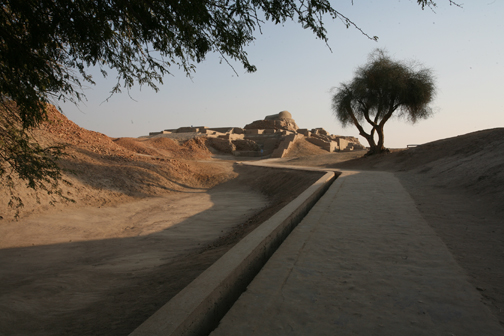
The civilization that emerged on its banks is the largest ancient civilization as it was spread over an area stretching from the foothills of Himalayas in the North to the Arabian Sea coast in the South and from the Pakistan Iranian borderlands in the West to Gujrat in India in the East.  So far about 1500 sites have been identified as the ancient Indus sites; Moen jo Daro, translated Mound of the Dead, being the largest.  Harappa, Kali Bangan, Rakhigarhi, Lothal, Dholavira are a few other larger sites.

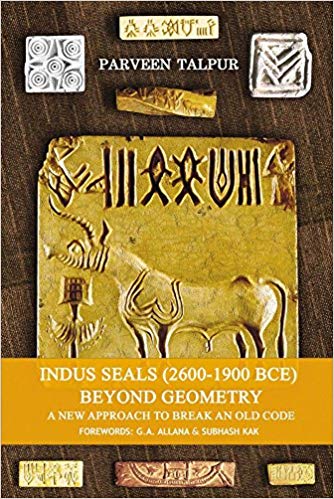
Indus Civilization remains mysterious as the script and symbols, engraved on tiny steatite seals, discovered from its ruins are not yet deciphered.  The Civilization has also gone unrecorded in history.  Whereas its contemporaneous Egyptian and Mesopotamian civilizations are mentioned in Bible, Indus Civilization has no reference in the earliest Indian texts such as the Vedas and the Mahabharata.  It had lasted for seven centuries but it did not mature to a state organized empire and remained arrested in an urban phase.  Moen jo Daro, the most elaborate site, therefore lacks in palaces, temples and royal tombs it even lacks a cemetery!  At one point in time the city had an estimated population of 50,000.  Where did it disappear?